Showing posts with label Vocabulary. Show all posts

Wednesday, May 25, 2022

Recruitment (Vocabulary: Business Terms)

RECRUITMENT (Vocabulary: Business Terms)

Recruitment is the process of finding suitable candidates to fill a position in a company. Steps include:

  • identifying and spelling out the need;
  • attracting candidates (by word of mouth or some times by advertising);
  • interviewing and selecting the right candidate; and
  • hiring and bringing the person onto staff.

In larger companies this may be done by the Human Resources ("HR") Department. The next step will probably be training. A person who has just been recruited might be called a "new recruit."


Recruiting techniques may include:

  • Internal recruitment: hiring current employees to a new position;
  • External recruiters: Hiring professionals to find your ideal candidates;
  • Career fairs (also called "job fairs"): Attending events where candidates meet with representatives of several companies;
  • Campus recruiting: Like a job fair for hiring soon-to-be graduates.


Navigation:

(Image courtesy Wikimedia Commons; CTTO)

Tuesday, May 24, 2022

Reproductive cloning (Scientific Advances)

REPRODUCTIVE CLONING (Scientific Advances)

Reproductive cloning (also called "organism cloning") is the implantation of a cloned embryo into a uterus, whether natural or artificial. The embryo then develops into a fetus that is then carried to full term. Dolly the Sheep was the first mammal cloned from an adult somatic (non-reproductive) cell, back in 1996, the result of some 435 attempts; she lived for six years, until euthanized due to a progressive lung disease unrelated to being cloned. Prior to Dolly, frogs and various kinds of fish had been cloned; since Dolly, a wide variety of mammals has been reproductively cloned, but no humans--so far, due to ethical concerns. (Therapeutic cloning--the creation of tissues for use in medical procedures--is being actively researched, but has not been put into practice.)


Navigation:

(Image courtesy Wikimedia Commons; CTTO)

Tuesday, May 17, 2022

Literary Genres (Vocabulary: Art Terms)

LITERARY GENRES (Vocabulary: Art Terms)

Here are five genres (categories) of writing and the people who write them:

  • novels and novellas: These are longer works of fiction; shorter novels may be called novellas (though there is no exact number of pages to divide one from the other). People who write novels or novellas are called novelists.
  • short stories: These are decidedly shorter works of fiction. Where a novel may have multiple plots and subplots, a short story is generally a single "thread" of story. There is no special word for people who write short stories; we usually just say "short story writers."
  • poems: Poems, of course, are different from the above two genres (which are called prose). They may have a special rhyme or meter (or they may not) but they're usually fairly easy to recognize. People who write poems are called poets.
  • plays or dramas: These are works written to be performed, usually live on a stage. They may be serious (dramas or tragedies) or amusing (comedies). In any case, the people that write them may be called playwrights or dramatists.
  • essays: These are thought pieces, usually based on facts and including the writer's ideas about those facts. Such writers are called essayists.

There are of course other types of writing--for films, songs, speeches, textbooks, and so on. But these are the main types for what we call "literature."


Navigation:

(Image courtesy Wikimedia Commons; CTTO)

Tuesday, May 10, 2022

Synonyms and Antonyms (Written Conventions of English)

SYNONYMS AND ANTONYMS (Written Conventions of English)

A synonym is a word or phrase that means the same or nearly the same as another. These can be found in a book called a thesaurus. For "book" (noun), we find words like: album, manual, novel, paperback, textbook, and volume. As you can see, these do not have exactly the same meaning as book, but you could put book in place of them.

Antonyms are opposites, and come in three types:

  • graded antonyms lie on a continuous spectrum, like hot/cold, fat/thin, young/old, and dull/interesting;
  • complementary antonyms' meanings do not lie on a spectrum, like push/pull, odd/even, exit/enter, and exhale/inhale; and
  • relational antonyms make sense only in the context of a relationship, like husband/wife, doctor/patient, teach/learn, and parent/child.


Here's a fun one: auto-antonyms or "Janus words" can be their own opposites, depending on context:

  • sanction can mean to permit or prohibit;
  • fast can mean moving quickly or stuck in one place;
  • dust can mean put dust on or take dust off;

and so on.


Navigation:

(Image courtesy Wikimedia Commons; CTTO)

Monday, May 9, 2022

Protocol (Vocabulary: Science and Government Terms)

PROTOCOL (Vocabulary: Science and Government Terms)

Protocol originally meant something like "a summary on the first page of a document." But it has come to mean a proper procedure, and is often used in these four fields:

  • politics: a formal agreement between nation states, as the Kyoto Protocol, a former international treaty aimed at reducing green house gas emissions.
  • diplomacy: protocols are a set of international courtesy rules, meant to maintain harmony in meetings and negotiations even between hostile nations.
  • science: protocols are predefined written procedures for conducting experiments. They help standardize methods to permit replication of results by others.
  • computers: a communication protocol is a system of rules that allows two or more elements in a communications system to--well--communicate. For example, the "http:" you see at the start of every full URL means "HyperText Transfer Protocol."

Navigation:

(Image courtesy Wikimedia Commons; CTTO)

Saturday, April 30, 2022

Conjunctions (Vocabulary: Language Study Terms)

CONJUNCTIONS (Vocabulary: Language Study Terms)

A conjunction joins two or more:

  • words: 
              Their pets are black and white.
  • phrases:
              They have a black dog and a white cat.
  • sentences:
              Art has a black dog, and Ann has a white cat.

The most common conjunctions are:

  • and (adds)
              I like big and small dogs.
  • or (shows a choice)
              Do you prefer a big dog or a small dog?
  • but (shows a difference)
              I like big dogs, but not small dogs.

  • There are many, many more conjunctions, like: after, although, as, because, before, nor, since, so, than, that, though, unless, until, when, whenever, where, while, yet...

and lots more!


Navigation:

(Image courtesy Wikimedia Commons; CTTO)

Tuesday, April 26, 2022

Davy Jones' Locker (Idiom)

DAVY JONES' LOCKER (Idiom)

Davy Jones' Locker is a nickname used by sailors for the bottom of the sea, where shipwrecks and drowned sailors settle. "Being sent to Davy Jones' Locker" is a euphemism for drowning. As for Davy himself, no one quite knows how the name came about. He's first mentioned in a 1726 book by Daniel Defoe (author of Robinson Crusoe). "Davy" may come from "duppy" (or duffy), a West Indian word for a malevolent spirit or ghost; "Jones" may refer to Jonah, who was cast into the sea in the Bible and ended up in the belly of a "great fish." In any case, he's the sailors' devil, and is described by author Tobias Smollett (in 1751) as having eyes like saucers; three rows of teeth; horns and a tail (like any devil); and blue smoke coming from his nostrils. He has more recently been sighted with octopus tentacles for a beard and a crab claw for a hand in Disney's Pirates of the Caribbean film series.


Navigation:

(Image courtesy Wikimedia Commons; CTTO)

Monday, April 25, 2022

Upper- and Lower-Case Letters (Written Conventions of English)

UPPER- AND LOWER-CASE LETTERS (Written Conventions of English)

  • Upper-case letters = "Capital letters" - A, B, C, D, etc.
  • Lower-case letters = "small letters"   -  a, b, c, d, etc.

Capitalize:

  • the first word of a sentence: Never sit on a cactus.
  • the first word of a quote: He said, "Never sit on a cactus."
  • the pronoun I: He sat on a cactus, but I didn't.
  • proper nouns: My friend Bill sat on a cactus in Arizona.
  • a person's title (sometimes): President Joe Biden, but Joe Biden is the current president of America.
  • days, months, historical eras, and holidays (not seasons): Monday, April, the Renaissance, Christmas, but winter
  • cardinal directions naming a place: the South, Eastern Europe, but Chicago is east of New York.
  • initials and acronyms: J. F. Kennedy, U.S.A. or USA / NATO

--------

In a title:

  • YES: the first word, nouns, verbs, adjectives, and adverbs
  • NO: articles, conjunctions, and prepositions

    To Kill a Mockingbird, Gone with the Wind

NOTE: In informal writing, entire words can be capitalized for emphasis: HE didn't sit on a cactus; YOU sat on a cactus.


Navigation:

(Image courtesy Wikimedia Commons; CTTO)

Sunday, April 24, 2022

Globalization (Vocabulary: Business Terms)

GLOBALIZATION (Vocabulary: Business Terms)

Globalization is a process in which people, companies, and governments interact and integrate worldwide. Its roots lie in the increase in travel, transportation and communication that began 200 years or so ago. Mainly an economic process, it has also had vast cultural and political consequences. While largely positive, it has also resulted in some important negative effects: loss of control by local communities, loss of jobs in more developed economies and an increase in "sweat shop" industries globally, faster spread of disease, greater opportunities for terrorism, an increased "income gap" between countries, a "domino effect" in supply chain disruptions, and so on. Despite all this (and the increasing isolationism in some countries) it seems that globalization is here to stay.


Navigation:

(Image courtesy Wikimedia Commons; CTTO)

Monday, April 18, 2022

Concerto (Vocabulary: Art Terms)

CONCERTO (Vocabulary: Art Terms)

For the most part, a concerto (pronounced kun-CHAIR-toe) is a composition for one or more soloists accompanied by an orchestra or, sometimes, a smaller musical ensemble. Typically it is in three movements with the tempos fast-slow-fast. The concerto actually originated as a form of vocal music, but has been understood as an instrumental piece since the late 17th or early 18th. Violin and piano have been popular instruments for concerti, but they have been written for nearly every instrument--for example, guitar, saxophone, trombone, harpsichord, accordion, harmonica, voices, and multiple instruments or vocal soloists. There have even been concerti for bowls of water, a florist, and a tap dancer!


Navigation:

(Image courtesy Wikimedia Commons; CTTO)

Tuesday, April 12, 2022

predator (Vocabulary: Science Terms)

PREDATOR (Vocabulary: Science Terms)

A predator is an animal (or, rarely, a plant, such as the Venus flytrap) that eats other animals, which are known as prey. Animals which eat prey that is already dead are called scavengers; some animals are both predators and scavengers. Predators' senses and bodies are often uniquely adapted to predation, e.g., with eyes on the front of the head (binocular vision permits precise location), keen hearing, sharp teeth and claws, etc. Some predators are solitary hunters, while others engage in social predation in highly complex groups (e.g. wolf packs or lion prides).

  • Few domesticated animals are predators, with dogs and cats a notable exception.


Navigation:

(Image courtesy Wikimedia Commons; CTTO)

Wednesday, April 6, 2022

The Eight Parts of Speech (Vocabulary: Language Study Terms)

THE EIGHT PARTS OF SPEECH (Vocabulary: Language Study Terms)

All English words belong to one (or more) of eight parts of speech. The part of a word sometimes depends on how it's used: "bank" can be a noun (a place) or a verb (to do business at a bank). Here are the eight parts and what they do:

  • Noun: names a person, place, thing, or idea: BARBERS, BEIJING, BUTTERFLIES, and BEAUTY.
  • Pronoun: takes the place of a noun. Subject: I, YOU, HE, etc. Object: ME, YOU, HIM, etc. Possessive: MINE, YOURS, HIS.
  • Adjective: modifies a noun or pronoun, telling which, whose, what kind, and how many about the nouns and pronouns they modify. THE LITTLE BROWN dog ran free in A PUBLIC park--LUCKY her!
  • Verb: describes the action (EAT, ATE, EATEN, EATING) or condition (IS happy, SMELLS nice).
  • Adverb: Here, really modifies a verb ("really RAN"); ("really RAN"); an adjective ("a really BIG race"); or another adverb ("ran really FAST.")
  • Conjunction: joins words ("I like books AND music"); phrases ("I like to read books OR listen to music"); or clauses ("I like to read books, BUT you like to listen to music.") AND, OR, and BUT are the most common, but there are many more.
  • Preposition: shows the relationship between a noun or pronoun ("the object of the preposition") and a verb or other noun in a sentence. Verb to noun (sat UNDER table): "The dog sat UNDER the table." Noun to noun (vase WITH flowers): "The vase WITH the flowers was beautiful."
  • Interjection: shows emotion, and has no grammatical relationship to the words around it, such as WOW! OH? HELLO! and YES.


Navigation:

(Image courtesy Wikimedia Commons; CTTO)

Thursday, March 31, 2022

e- combining form (Vocabulary: Business Terms)

E- COMBINING FORM (Vocabulary: Business Terms)

With over four billion accounts worldwide, it's safe to say that everyone knows what e-mail (or email) is. But did you know that the e- stands for "electronic"? (Although sometimes it stands for "electric," as in "e-bike.") That abbreviation was coined as early as 1971, and the e- combining form has been used in numerous words since, including such common ones as e-commerce, e-book, and the auction site eBay, as well as around 300 more, many of which you may never have heard of: e-hug, for example, or e-skin. Some e- words are more commonly used with the prefix "cyber-": cybercrime rather than e-crime, or cyberwarfare instead of e-warfare.


Navigation:

(Image courtesy Wikimedia Commons; CTTO)

Sunday, March 27, 2022

5 Money Idioms

FIVE IDIOMS ABOUT MONEY

IDIOM: megabucks
• MEANING: a lot of money
• EXAMPLE: Since she changed jobs, she's making megabucks.

IDIOM: a fast buck
• MEANING: money made easily
• EXAMPLE: All he wants to do is make a fast buck without hard work.

IDIOM: the gravy train
• MEANING: a position that provides easy money
• EXAMPLE: Since my promotion I've been on the gravy train.

IDIOM: a cash cow
• MEANING: something that provides steady money
• EXAMPLE: Her new company makes lots of money; it's a cash cow.

IDIOM: nickel-and-dime
• MEANING: small amounts of money
• EXAMPLE: I need a better job; I'm tired of this nickel-and-dime stuff.


Navigation:

(Image courtesy Wikimedia Commons; CTTO)

Friday, March 25, 2022

aesthetic, aesthetics (Vocabulary: Art Terms)


AESTHETIC, AESTHETICS (Vocabulary: Art Terms)

Two closely-related words:

  • Aesthetics (sometimes esthetics) is a branch of philosophy concerned with beauty and related concepts in the fine arts. It asks how we can judge what is beautiful in the visual arts, literature, the performing arts and music, and even nature.
  • Aesthetic (sometimes esthetic) is, first, simply the adjective form of aesthetics. We can talk about the aesthetic quality of something (is it beautiful or not), or we can say something is aesthetically (adverb) pleasing. Also, however, aesthetic can be a noun: "The house's design reflected a modern aesthetic," or "She brought a refined aesthetic to her fashions."


Navigation:

(Image courtesy Wikimedia Commons; CTTO)

Saturday, March 19, 2022

Binary (Vocabulary: Science Terms)

BINARY (Vocabulary: Science Terms)

The number system we usually use is called "decimal" or "base-10." In it, there is no number for 10 per se: we count up in the "ones" column, and when we reach 10 we put a "1" in the "tens" column and a "0" in the "ones."

So as you may guess, in the "binary" (or "base-2") system, there is no figure for "2," but a "1" in the "twos" column. (As the decimal columns are 1, 10, 100, 1000, and so on--each ten times more than the last--the binary columns are 1, 2, 4, 8, and so on, each one twice the last.)

The easiest way to design a computer is to set things up in binary: on/off, yes/no and so on. A switch (or "gate") may be either open or closed; a series of open and closed switches can represent numbers, letters, and even pictures. Marvelous!

And so BINARY has become an important word for us.

The downside of a base-2 system is that small numbers can be mighty complicated to write: my age, for example, is only 66, but in base-2 it looks like 1000010 (that's 1 x 64 + 1 x 2)!


Navigation:

(Image courtesy Wikimedia Commons; CTTO)

Sunday, March 13, 2022

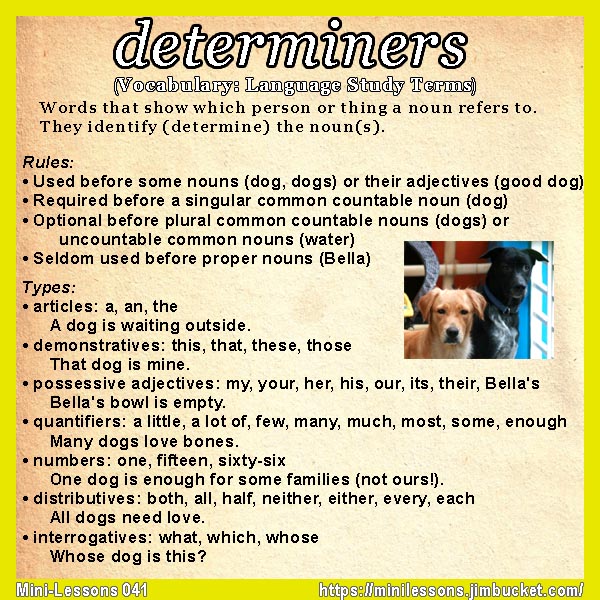
Determiners (Vocabulary: Language Study Terms)

DETERMINERS (Vocabulary: Language Study Terms)

Words that show which person or thing a noun refers to. They identify (determine) the noun(s).

Rules:

  • Used before some nouns (dog, dogs) or their adjectives (good dog)
  • Required before a singular common countable noun (dog)
  • Optional before plural common countable nouns (dogs) or uncountable common nouns (water)
  • Seldom used before proper nouns (Bella)

Types:

  • articles: a, an, the
    • A dog is waiting outside.
  • demonstratives: this, that, these, those
    • That dog is mine.
  • possessive adjectives: my, your, her, his, our, its, their, Bella's
    • Bella's bowl is empty.
  • quantifiers: a little, a lot of, few, many, much, most, some, enough
    • Many dogs love bones.
  • numbers: one, fifteen, sixty-six
    • One dog is enough for some families (not ours!).
  • distributives: both, all, half, neither, either, every, each
    • All dogs need love.
  • interrogatives: what, which, whose
    • Whose dog is this?

Navigation:

(Image courtesy Wikimedia Commons; CTTO)

Monday, March 7, 2022

Biotechnology (Vocabulary: Business Terms)

BIOTECHNOLOGY (Vocabulary: Business Terms)

Biotechnology is defined as "the integration of natural sciences and engineering sciences in order to achieve the application of organisms, cells, parts thereof and molecular analogues for products and services." An older (and simpler) definition says it's the making of products from raw materials with the aid of living organisms. Today this may include genetic engineering and technologies involving cell and tissue culture. It has applications in medicine, food production, industrial processes (e.g. producing chemicals), and environmental issues.

  • Global revenue from "biotech" was expected to reach over $1.006 billion in 2021.


Navigation:

(Image courtesy Wikimedia Commons; CTTO)

Wednesday, February 23, 2022

Serum (Vocabulary: Science Terms)

SERUM (Vocabulary: Science Terms)

Many medical terms we use are specific. But this one, serum (plural sera) can mean any clear or watery bodily fluid--in humans, animals, or even plants. These may also be called serous fluids. (The adjective is also seen in phrases like serous discharge or serous drainage.) Some specific sera:

  • blood serum: the fluid component of blood plasma without clotting factors. Blood serum carries, but does not include, white blood cells, red blood cells, platelets, and clotting factors.
  • antiserum (also called immune serum) is a blood serum that contain antibodies.
  • truth serum is a largely unproven substance, including certain drugs, that may compel subjects to tell the truth, but more likely just reduces inhibitions.

The study of sera is called serology, and the practitioner is a serologist.

(Image courtesy Wikimedia Commons; CTTO)


Thursday, February 17, 2022

Question tag (Vocabulary: Language Terms)

QUESTION TAGS (Vocabulary: Language Terms)

Also called Tag Questions, these turn a statement into a question. They look like this:

Statement + Short Question

  • Example: Becky is your friend, isn't she?

The question part uses the statement's modal plus its subject, always in the pronoun form.

Becky is <--> isn't she (pronoun form of Becky)

In a positive statement, the question is negative.

In a negative statement, the question is positive.

  • Example: Becky isn't from here, is she?

--------

Special cases: use--

  • "aren't" for "am": I'm late, aren't I?
  • "it" for "this" or "that": That's true, isn't it?
  • "they" for "these" or "those": Those are the facts, aren't they?
  • "there" for statements starting with "there": There's a hole in my sock, isn't there?
  • "they" for "nobody," "someone," "everybody," etc.: Nobody's happy, are they?

Modals: do, be, have, will, can, must, should, could, would, etc.

(Image courtesy Wikimedia Commons; CTTO)