Showing posts with label Language Study Terms. Show all posts

Saturday, April 30, 2022

Conjunctions (Vocabulary: Language Study Terms)

CONJUNCTIONS (Vocabulary: Language Study Terms)

A conjunction joins two or more:

  • words: 
              Their pets are black and white.
  • phrases:
              They have a black dog and a white cat.
  • sentences:
              Art has a black dog, and Ann has a white cat.

The most common conjunctions are:

  • and (adds)
              I like big and small dogs.
  • or (shows a choice)
              Do you prefer a big dog or a small dog?
  • but (shows a difference)
              I like big dogs, but not small dogs.

  • There are many, many more conjunctions, like: after, although, as, because, before, nor, since, so, than, that, though, unless, until, when, whenever, where, while, yet...

and lots more!


Navigation:

(Image courtesy Wikimedia Commons; CTTO)

Wednesday, April 6, 2022

The Eight Parts of Speech (Vocabulary: Language Study Terms)

THE EIGHT PARTS OF SPEECH (Vocabulary: Language Study Terms)

All English words belong to one (or more) of eight parts of speech. The part of a word sometimes depends on how it's used: "bank" can be a noun (a place) or a verb (to do business at a bank). Here are the eight parts and what they do:

  • Noun: names a person, place, thing, or idea: BARBERS, BEIJING, BUTTERFLIES, and BEAUTY.
  • Pronoun: takes the place of a noun. Subject: I, YOU, HE, etc. Object: ME, YOU, HIM, etc. Possessive: MINE, YOURS, HIS.
  • Adjective: modifies a noun or pronoun, telling which, whose, what kind, and how many about the nouns and pronouns they modify. THE LITTLE BROWN dog ran free in A PUBLIC park--LUCKY her!
  • Verb: describes the action (EAT, ATE, EATEN, EATING) or condition (IS happy, SMELLS nice).
  • Adverb: Here, really modifies a verb ("really RAN"); ("really RAN"); an adjective ("a really BIG race"); or another adverb ("ran really FAST.")
  • Conjunction: joins words ("I like books AND music"); phrases ("I like to read books OR listen to music"); or clauses ("I like to read books, BUT you like to listen to music.") AND, OR, and BUT are the most common, but there are many more.
  • Preposition: shows the relationship between a noun or pronoun ("the object of the preposition") and a verb or other noun in a sentence. Verb to noun (sat UNDER table): "The dog sat UNDER the table." Noun to noun (vase WITH flowers): "The vase WITH the flowers was beautiful."
  • Interjection: shows emotion, and has no grammatical relationship to the words around it, such as WOW! OH? HELLO! and YES.


Navigation:

(Image courtesy Wikimedia Commons; CTTO)

Sunday, March 13, 2022

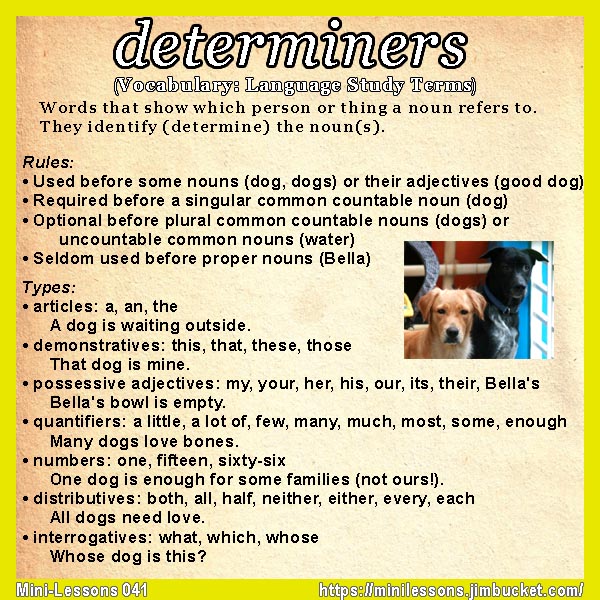
Determiners (Vocabulary: Language Study Terms)

DETERMINERS (Vocabulary: Language Study Terms)

Words that show which person or thing a noun refers to. They identify (determine) the noun(s).

Rules:

  • Used before some nouns (dog, dogs) or their adjectives (good dog)
  • Required before a singular common countable noun (dog)
  • Optional before plural common countable nouns (dogs) or uncountable common nouns (water)
  • Seldom used before proper nouns (Bella)

Types:

  • articles: a, an, the
    • A dog is waiting outside.
  • demonstratives: this, that, these, those
    • That dog is mine.
  • possessive adjectives: my, your, her, his, our, its, their, Bella's
    • Bella's bowl is empty.
  • quantifiers: a little, a lot of, few, many, much, most, some, enough
    • Many dogs love bones.
  • numbers: one, fifteen, sixty-six
    • One dog is enough for some families (not ours!).
  • distributives: both, all, half, neither, either, every, each
    • All dogs need love.
  • interrogatives: what, which, whose
    • Whose dog is this?

Navigation:

(Image courtesy Wikimedia Commons; CTTO)