Showing posts with label Cultural Knowledge. Show all posts

Tuesday, May 24, 2022

Reproductive cloning (Scientific Advances)

REPRODUCTIVE CLONING (Scientific Advances)

Reproductive cloning (also called "organism cloning") is the implantation of a cloned embryo into a uterus, whether natural or artificial. The embryo then develops into a fetus that is then carried to full term. Dolly the Sheep was the first mammal cloned from an adult somatic (non-reproductive) cell, back in 1996, the result of some 435 attempts; she lived for six years, until euthanized due to a progressive lung disease unrelated to being cloned. Prior to Dolly, frogs and various kinds of fish had been cloned; since Dolly, a wide variety of mammals has been reproductively cloned, but no humans--so far, due to ethical concerns. (Therapeutic cloning--the creation of tissues for use in medical procedures--is being actively researched, but has not been put into practice.)


Navigation:

(Image courtesy Wikimedia Commons; CTTO)

Monday, May 16, 2022

Logic (Philosophy)

LOGIC (Philosophy)

In everyday speech, "logic" just means something like "clear thinking." But in formal terms, there are straightforward rules like these:

  • If A, then B; A, therefore B.

Example: If I work 8 hours, I will be paid $120; I worked 8 hours, therefore I got paid $120.

  • Similarly, if A, then B; not A, therefore not B.

Example: I always smile when I'm happy; I'm not smiling, so I must not be happy.

  • A is B; C is A. Therefore C is B.

Example: All humans are mortal; Socrates is human; therefore Socrates is mortal.

  • Either A is true or B is true. One of these isn't true, so the other must be.

Example: Only two people could have murdered Pat--Mike or Doug. But Doug was in Spain, therefore Mike killed Pat.

--------

Valid is not the same as true. The arguments are valid, so the conclusion ("therefore") is valid. But the premises (the first parts) must be true for the conclusion to be true. In the last example, if Doug wasn't in Spain, he still could have killed Pat.


Navigation:

(Image courtesy Wikimedia Commons; CTTO)

Thursday, May 12, 2022

Las Meninas (Great Art)

LAS MENINAS (Diego Velázquez, Spanish, 1656)

Las Meninas ("The Ladies-in-waiting") is a large (over 10 x 9 feet) 1656 painting by Diego Velázquez (1599-1660), the leading artist of the Spanish Golden Age. The focus--the little girl in white--is the "Infanta" (Princess) Margaret Theresa. On either side of her are the titular ladies in waiting; to our right, two dwarfs (one with his foot on the dog); behind the dwarfs a chaperone and a guard; in the doorway behind, the queen's chamberlain; and on the left, facing a large easel with its back to us, is the artist Velázquez himself. Intriguingly, a mirror hangs on the wall above the Infanta's head; in it are her parents, Spain's King Philip IV and his wife, Mariana of Austria. It has been suggested that they are sitting for a portrait by Velázquez, and the painting we see here is what they would have been looking at as they patiently sit. The ladies, it has been suggested, are trying to cajole the Infanta into joining her parents for the portrait. Marvelous!


Navigation:

(Image courtesy Wikimedia Commons; CTTO)

Friday, May 6, 2022

Modern Alphabets (Historical Events)

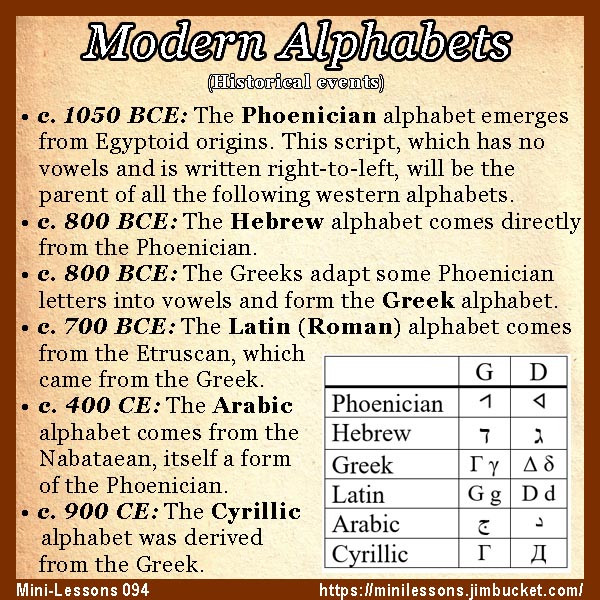
MODERN ALPHABETS (Historical events)

  • c. 1050 BCE: The Phoenician alphabet emerges from Egyptoid origins. This script, which has no vowels and is written right-to-left, will be the parent of all the following western alphabets.
  • c. 800 BCE: The Hebrew alphabet comes directly from the Phoenician.
  • c. 800 BCE: The Greeks adapt some Phoenician letters into vowels and form the Greek alphabet.
  • c. 700 BCE: The Latin (Roman) alphabet comes from the Etruscan, which came from the Greek.
  • c. 400 CE: The Arabic alphabet comes from the Nabataean, itself a form of the Phoenician.
  • c. 900 CE: The Cyrillic alphabet was derived from the Greek.


Navigation:

(Image courtesy Wikimedia Commons; CTTO)

Friday, April 29, 2022

The Baconian Method (Cultural Knowledge: History of Science)

THE BACONIAN METHOD (Cultural Knowledge: History of Science)

The Elizabethan philosopher Sir Francis Bacon (1561-1626) has been called one of the founders of modern science, based partly on his description of a process sometimes called the Baconian method, one of the first formulations of a modern method of scientific investigation. It was put forward in his 1620 book Novum Organum ("New Method"), a replacement for an outdated system attributed to Aristotle called the Organon. Today the process is described like this:

  • Observe and question: Decide what it is you want to understand.
  • Research the topic area: See what others have done with this topic.
  • Make a hypothesis: "Guess" what the answer might be.
  • Test the hypothesis using experiments: Find ways (that can be repeated by others) to see if your "guess" is true.
  • Analyze the data gained by experimentation: Follow the data to a result or results.
  • Report the conclusions: Let others know what you have done.
  • Your conclusions will become the basis for further research by you or others.

Although it's not always this straightforward, the "scientific method" is how we've gathered much of today's understanding of the world.


Navigation:

(Image courtesy Wikimedia Commons; CTTO)

Tuesday, April 26, 2022

Davy Jones' Locker (Idiom)

DAVY JONES' LOCKER (Idiom)

Davy Jones' Locker is a nickname used by sailors for the bottom of the sea, where shipwrecks and drowned sailors settle. "Being sent to Davy Jones' Locker" is a euphemism for drowning. As for Davy himself, no one quite knows how the name came about. He's first mentioned in a 1726 book by Daniel Defoe (author of Robinson Crusoe). "Davy" may come from "duppy" (or duffy), a West Indian word for a malevolent spirit or ghost; "Jones" may refer to Jonah, who was cast into the sea in the Bible and ended up in the belly of a "great fish." In any case, he's the sailors' devil, and is described by author Tobias Smollett (in 1751) as having eyes like saucers; three rows of teeth; horns and a tail (like any devil); and blue smoke coming from his nostrils. He has more recently been sighted with octopus tentacles for a beard and a crab claw for a hand in Disney's Pirates of the Caribbean film series.


Navigation:

(Image courtesy Wikimedia Commons; CTTO)

Saturday, April 23, 2022

The Phoenix (Mythology)

THE PHOENIX (Mythology)

The phoenix is an immortal bird which, though mythical, was once believed to be real. Her "natural history" claims that she would cyclically regenerate: dedicated to the sun, when she reached extreme age, she would build a spectacular nest of cinnamon bark, herbs, and myrrh in a special tree  in her desert abode, and the sun would cause her to burst into flame. From the ashes of her destruction a new phoenix was born. This act caused the phoenix to become a symbol of renewal: the sun's return, the cycles of the seasons, the rise and fall of empires, life in heaven, and resurrection itself.


Navigation:

(Image courtesy Wikimedia Commons; CTTO)

Sunday, April 17, 2022

The Code of Hammurabi

THE CODE OF HAMMURABI (Babylonian, c. 1750 BCE)

This Babylonian legal text--the longest and best from the ancient Near East--was written in Akkadian by Hammurabi, the 6th king of the First Dynasty of Babylon, on a basalt stele 7' feet 4-1⁄2" tall. It was rediscovered in 1901 in the ruins of Susa in present Iran; it was copied and studied by Mesopotamian scribes for over 1,000 years. It has an image of Hammurabi with Shamash, god of the sun and of justice. Four-fifths of its 4,130 lines of cuneiform contain the laws; the rest is poetic prologue and epilogue. Hammurabi's purpose is "to prevent the strong from oppressing the weak."

  • An example of the "if/then" style: "If a man accuses another man and charges him with homicide, but cannot bring proof against him, his accuser shall be killed."


Navigation:

(Image courtesy Wikimedia Commons; CTTO)

Wednesday, March 30, 2022

Early Writing (Cultural Knowledge)

EARLY WRITING (Sumer and Egypt, 3400-3100 BCE)

For millennia the only way to pass information from one person to another--or from one generation to the next--was through the spoken word. Then came proto-writing, the use of symbols to indicate things, useful as reminders but not representing language per se--perhaps a little like a shopping list. At last, sometime between 3400-3100 BCE, and probably in the "Fertile Crescent" (which runs from Mesopotamia though Assyria and Phoenicia to Egypt) came true writing, the earliest known forms of which include the cuneiform ("wedge-shaped") script from Sumer (in Mesopotamia) and Egyptian hieroglyphs. Most of our modern alphabets derive from hieroglyphics through a long and complicated history.


Navigation:

(Image courtesy Wikimedia Commons; CTTO)

Monday, March 28, 2022

Nocturne, Op. 9, No. 2 (Chopin) (Great Music)

NOCTURNE, OP. 9, NO. 2 (Chopin, Polish, 1832)

A nocturne (from the French for "nocturnal") is a musical composition that evokes the mystery of the nighttime. Between 1827 and 1846, the Polish composer Frederic Chopin wrote 21 nocturnes for solo piano. Though others have written them, so effective were his nocturnes that the form has become associated with his name. His nocturnes are considered among the finest short solo works for piano; they are an important part of the pianists' modern concert repertoire. The composer's Opus 9 is made up of three such works, and the second--"Nocturne in E-flat major, Op. 9, No. 2"--is considered the best of all his nocturnes. It is a delight to listen to, and exudes a feeling of peace--as nighttime should.


Navigation:

(Image courtesy Wikimedia Commons; CTTO)

Thursday, March 24, 2022

Vesalius (Cultural Knowledge: Scientific discoveries)

VESALIUS (Belgian anatomist, 1514-1564)

Andreas Vesalius was born in Belgium to generations of medical men, but also exhibited an interest in art. Academics in his day accepted the teachings of the early physician Galen (129-216 CE) as unassailable, but Vesalius nevertheless assailed them by doing his own dissections and encouraging his students to do the same. Vesalius also learned that Galen's conclusions were drawn from animal dissections; Vesalius published updated studies and illustrations of human anatomy, including most notably "On the fabric of the human body in seven books." Though his was not the only or even the first work based on actual human dissection, the quality of his work marks the establishment of human anatomy as a modern descriptive science.


Navigation:

(Image courtesy Wikimedia Commons; CTTO)

Friday, March 18, 2022

Lucifer (Religion/Mythology)

LUCIFER (religion)

The word lucifer means simply "one who brings light." But when we use it as a proper name, we may have one of three things in mind:

  • First, it is a name for the planet Venus seen in the morning, sometimes called "the morning star."
  • Second, the name has been applied (as a result of translations) to an angel who rebelled against God and--some say--fell from heaven with a third of all the angels. This story depends on piecing together numerous passages from both the Hebrew and the Christian scriptures.
  • Finally, Lucifer is used colloquially as a name for Satan, the enemy of God, in various stories from the Bible, theology, literature, and folk traditions.

Of course, any one of these may be any other, and some say all three are one and the same!


Navigation:

(Image courtesy Wikimedia Commons; CTTO)

Saturday, March 12, 2022

Wheeled vehicles (roughly 4,000 BCE)

WHEELED VEHICLES (roughly 4,000 BCE)

We tend to think of wheels as parts of vehicles. But millstones for grinding grain are wheels; so are potter's wheels, steering wheels, and a clock's cogs. No one knows when the wheel in the broadest sense was invented, though some claim it was the Mesopotamians. But evidence of the use of wheeled carts has been found in the Middle East, Europe, India, and China from around 6,000 years ago (more or less). Whether some cultures borrowed from others or all developed them independently is not known. Spoked wheels on chariots came around 2,000 BCE, and we were off to the races--or, actually, the battles, as war chariots were the latest thing. Wheeled toys from a little later have been found in the Americas, but without large beasts to pull them, wheeled vehicles seem not to have appeared there until after Europeans brought the horse.


Navigation:

(Image courtesy Wikimedia Commons; CTTO)

Sunday, March 6, 2022

William Harvey and the Circulation of Blood (1628)

WILLIAM HARVEY AND THE CIRCULATION OF BLOOD (1628)

Look at the veins in your arm. Can you see the blood moving in them? Probably not. You can feel your pulse or your heartbeat, but you can't really see where the blood is moving, or why. It was the genius of William Harvey (1578-1657)--physician to Kings James I and Charles I--that he was able to clearly and thoroughly described the action of the heart, and the ways in which blood is moved through the body. Harvey showed how the heart's left ventricle pushed "fresh" blood through the arteries of the body, and when the "spent" blood returned the right ventricle sent it through the pulmonary artery to the lungs to be reoxygenated. He also discovered the function of the valves in the veins, which prevent blood from flowing backward (away from the heart).

  • This put Harvey at odds with the accepted theory: the Greek physician Galen (129-216 CE) thought that the heart produced heat, and the lungs cooled the blood like a radiator.


Navigation:

(Image courtesy Wikimedia Commons; CTTO)

Monday, February 28, 2022

Litany (Religion)

LITANY (Religion)

A litany is a form of prayer in which the minister reads a list, and the congregation answers the same way each time with things like "Lord, hear our prayer," or, "Good Lord, deliver us."

The Episcopal Church uses a "Great Litany" that says in part:

From all blindness of heart; from pride, vainglory, and hypocrisy; from envy, hatred, and malice; and from all want of charity,

          Good Lord, deliver us.

From all inordinate and sinful affections; and from all the deceits of the world, the flesh, and the devil,

         Good Lord, deliver us.

And, later:

That it may please thee to bless and keep all thy people,

          We beseech thee to hear us, good Lord.

...

That it may please thee to give us a heart to love and fear thee, and diligently to live after thy commandments,

          We beseech thee to hear us, good Lord.

  • Because the lists can be rather long, we sometimes speak of any long list casually as a "litany":

          Fred turned up late again with a whole litany of excuses.

  • View on Facebook or Instagram

(Image courtesy Wikimedia Commons; CTTO)


Tuesday, February 22, 2022

Cities (Cultural Knowledge)

CITIES (Mesopotamia, 6,000-5,000 BCE)

Most of us take for granted an early, important human innovation: the City. After all, the earliest cities we know of, in Mesopotamia, emerged some eight (or so) millennia ago. Though somewhat dated--after all, the book is nearly 70 years old--the slim little volume titled History Begins at Sumer, by the Assyriologist Samuel Noah Kramer, records 39 "firsts" of that long-ago civilization. Some of these are the first schools, the first "international" stand-off, the first law codes, the first "scientific" farming, the first flood story (and other Bible parallels), the first epic literature, the first aquarium, and many more. Notice that these go beyond mere survival into the finer aspects of what we consider civilization today--and this was starting in the 6th and 5th millennium BCE!

(Image courtesy Wikimedia Commons; CTTO)


Wednesday, February 16, 2022

Booker T. Washington (Cultural Knowledge)

BOOKER T. WASHINGTON (1856-1915)

This American educator, author, orator, and presidential adviser was born enslaved on a Virginia plantation five years before the start of the American Civil War. The illiterate boy taught himself to read and write around age 9 or 10, and worked hard--including in a coal mine--to pay for college. After graduation, just 25 years old, he was chosen to lead a new teacher's training college in Alabama, the Tuskegee Institute. He oversaw the purchase of land and the building of structures, the labor being performed by the students. He saw education as the solution to the oppression of American blacks, especially in the South. His emphasis was on practical trades: his students would not just learn to make buildings and to grow crops and farm animals, but to teach others to do the same. 

(Image courtesy Wikimedia Commons; CTTO)


Thursday, February 10, 2022

Mercury (Mythology)

MERCURY (Greco-Roman god)

A major god of the Roman religion, he is equal to Greek Hermes. The Messenger of the Gods, he is thus in charge of communication (including fortune-telling), eloquence, commerce, financial gain, travelers, boundaries, luck, trickery, and thieves. He also conducts souls to the underworld. Possibly a son of Jupiter (Greek Zeus), he is often seen holding the caduceus (the staff with intertwined snakes) in his left hand. (Through an error of symbology, this is associated with the medical profession today.)

  • The planet is named for this messenger god because of the apparent speed of its motion across the sky.
  • The element mercury, too, seems "fast," so was named for the planet, not the god.
  • The adjective "mercurial" indicates rapid changeability.

(Image courtesy Wikimedia Commons; CTTO)


Friday, February 4, 2022

The Agricultural Revolution (Historical event)

THE AGRICULTURAL REVOLUTION (The Middle East, c. 10,000 BCE)

The Agricultural Revolution (also called the First Agricultural or the Neolithic Revolution) was one of the first recognizable steps toward civilization as we know it today, following such developments as fire and stone tools. Nomadic groups of hunters and gatherers gradually became farmers and herders, creating more settled communities--villages, towns, and eventually cities, the very root of the word "civilization"--and developing a division of labor. Population sizes increased and a surplus in foods led to an increase in leisure time. Writing, religion, government, increased commerce, and greater personal ownership of property followed, for better or for worse.

  • It should be noted that this tidy sequence of events has been increasingly challenged as more complex theories are developed to account for new evidence as it comes to light.

(Image courtesy Wikimedia Commons; CTTO)