Friday, May 13, 2022

Beauty is only skin deep (Proverb)

BEAUTY IS ONLY SKIN DEEP

Meaning: What's inside a person is more important than his/her appearance.

--------

Mini-Dialogue: Tony sees his friend Rick.

Tony: Hey, Rick. How's it going?
Rick: Hi Tony. Not so good. My girlfriend is always unhappy with me. Nothing I do is ever good enough for her.
Tony: Have you tried counseling?
Rick: She won't go! She thinks everything's fine.
Tony: Well, then, I don't see any choice: You have to break up with her!
Rick: I can't! She's so good looking! I'll never get a woman like that again.
Tony: I disagree. It's better to have someone ugly on the outside and beautiful on the inside than vice versa.
Rick: You really think so?
Tony: Yes!  "Beauty is only skin deep."
Rick: Maybe so. I'll think about it.

--------

Question: To whom would you use this proverb?

   A. To a friend with a not-so-good-looking boyfriend.
   B. To a friend who is sad because he's not good looking.
   C. To a friend with a beautiful girlfriend.

--------

ANSWER: B


Navigation:

(Image courtesy Wikimedia Commons; CTTO)


Navigation:

(Image courtesy Wikimedia Commons; CTTO)

Thursday, May 12, 2022

Las Meninas (Great Art)

LAS MENINAS (Diego Velázquez, Spanish, 1656)

Las Meninas ("The Ladies-in-waiting") is a large (over 10 x 9 feet) 1656 painting by Diego Velázquez (1599-1660), the leading artist of the Spanish Golden Age. The focus--the little girl in white--is the "Infanta" (Princess) Margaret Theresa. On either side of her are the titular ladies in waiting; to our right, two dwarfs (one with his foot on the dog); behind the dwarfs a chaperone and a guard; in the doorway behind, the queen's chamberlain; and on the left, facing a large easel with its back to us, is the artist Velázquez himself. Intriguingly, a mirror hangs on the wall above the Infanta's head; in it are her parents, Spain's King Philip IV and his wife, Mariana of Austria. It has been suggested that they are sitting for a portrait by Velázquez, and the painting we see here is what they would have been looking at as they patiently sit. The ladies, it has been suggested, are trying to cajole the Infanta into joining her parents for the portrait. Marvelous!


Navigation:

(Image courtesy Wikimedia Commons; CTTO)

Wednesday, May 11, 2022

The Glass Ceiling (Idiom)

THE GLASS CEILING (Idiom)

A "glass ceiling" is a metaphor for a form of discrimination in which a group--usually women, but also people of color--is subjected to unstated, "invisible" barriers: limitations to their advancement in a company, educational program, etc. People of East Asian descent are sometimes said to face a "bamboo ceiling."

One scholar says that a true glass ceiling must have four characteristics:

  1. the limitation can not explained by other insufficiencies of the employee
  2. the limitation is greater at higher levels of possible advancement 
  3. the limitation applies to chances for advancement, not just actual advancements
  4. the limitation increases over the course of a career


Navigation:

(Image courtesy Wikimedia Commons; CTTO)

Tuesday, May 10, 2022

Synonyms and Antonyms (Written Conventions of English)

SYNONYMS AND ANTONYMS (Written Conventions of English)

A synonym is a word or phrase that means the same or nearly the same as another. These can be found in a book called a thesaurus. For "book" (noun), we find words like: album, manual, novel, paperback, textbook, and volume. As you can see, these do not have exactly the same meaning as book, but you could put book in place of them.

Antonyms are opposites, and come in three types:

  • graded antonyms lie on a continuous spectrum, like hot/cold, fat/thin, young/old, and dull/interesting;
  • complementary antonyms' meanings do not lie on a spectrum, like push/pull, odd/even, exit/enter, and exhale/inhale; and
  • relational antonyms make sense only in the context of a relationship, like husband/wife, doctor/patient, teach/learn, and parent/child.


Here's a fun one: auto-antonyms or "Janus words" can be their own opposites, depending on context:

  • sanction can mean to permit or prohibit;
  • fast can mean moving quickly or stuck in one place;
  • dust can mean put dust on or take dust off;

and so on.


Navigation:

(Image courtesy Wikimedia Commons; CTTO)

Monday, May 9, 2022

Protocol (Vocabulary: Science and Government Terms)

PROTOCOL (Vocabulary: Science and Government Terms)

Protocol originally meant something like "a summary on the first page of a document." But it has come to mean a proper procedure, and is often used in these four fields:

  • politics: a formal agreement between nation states, as the Kyoto Protocol, a former international treaty aimed at reducing green house gas emissions.
  • diplomacy: protocols are a set of international courtesy rules, meant to maintain harmony in meetings and negotiations even between hostile nations.
  • science: protocols are predefined written procedures for conducting experiments. They help standardize methods to permit replication of results by others.
  • computers: a communication protocol is a system of rules that allows two or more elements in a communications system to--well--communicate. For example, the "http:" you see at the start of every full URL means "HyperText Transfer Protocol."

Navigation:

(Image courtesy Wikimedia Commons; CTTO)
Friday, May 6, 2022

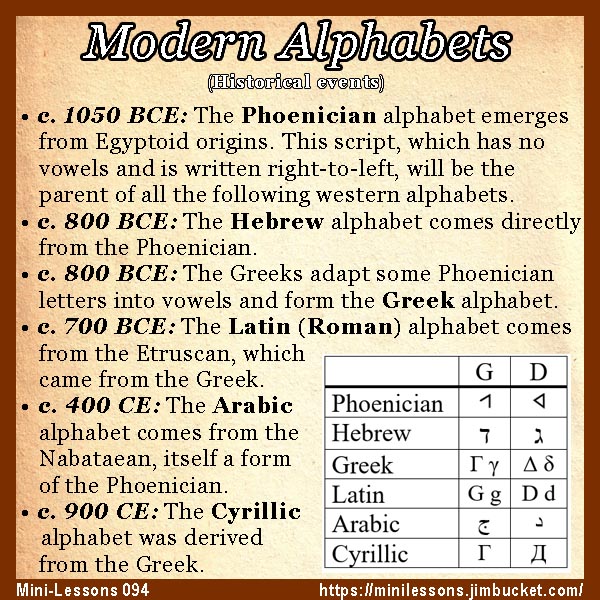
Modern Alphabets (Historical Events)

MODERN ALPHABETS (Historical events)

  • c. 1050 BCE: The Phoenician alphabet emerges from Egyptoid origins. This script, which has no vowels and is written right-to-left, will be the parent of all the following western alphabets.
  • c. 800 BCE: The Hebrew alphabet comes directly from the Phoenician.
  • c. 800 BCE: The Greeks adapt some Phoenician letters into vowels and form the Greek alphabet.
  • c. 700 BCE: The Latin (Roman) alphabet comes from the Etruscan, which came from the Greek.
  • c. 400 CE: The Arabic alphabet comes from the Nabataean, itself a form of the Phoenician.
  • c. 900 CE: The Cyrillic alphabet was derived from the Greek.


Navigation:

(Image courtesy Wikimedia Commons; CTTO)

Thursday, May 5, 2022

His bark is worse than his bite (Proverb)

HIS BARK IS WORSE THAN HIS BITE (Proverb)

Meaning: Someone may sound dangerous or scary, but not be that bad.

  • Most dogs make a lot of noise, but they seldom bite.

--------

Mini-Dialogue: Matt sees Dave in the company cafeteria.

Matt: Hi, Dave. What's wrong?
Dave: Oh, my new boss yells at me about everything!
Matt: Isn't Phil Sandler your boss?
Dave: Yes! Do you know him?
Matt: I sure do! He's tough, but "His bark is worse than his bite."
Dave: You mean...?
Matt: Besides the yelling, he's a pretty supportive boss. He won't really hurt you... much.
Dave: Well, I'll just have to take your word for it. 
Matt: Hang tough. You'll see!

--------

Question: To whom would you use this proverb?

   A. A friend whose teacher always scolds him.
   B. A friend with a mean dog.
   C. A friend who doesn't like his job.

--------

ANSWER: A


Navigation:

(Image courtesy Wikimedia Commons; CTTO)

Wednesday, May 4, 2022

5 Horse Idioms

FIVE IDIOMS USING THE WORD "HORSE"

IDIOM: back the wrong horse

  • MEANING: support the wrong candidate; make the wrong choice
  • EXAMPLE: I lost money on a bad investment; I backed the wrong horse!

IDIOM: beat a dead horse

  • MEANING: keep trying something after it's known to be useless
  • EXAMPLE: "Stop trying to change my mind; you're beating a dead horse!"

IDIOM: Don't change horses in mid-stream.

  • MEANING: Once we start something, we should follow through.
  • EXAMPLE: "Let's not switch strategies; we don't want to change horses in mid-stream."

IDIOM: put the cart before the horse

  • MEANING: do things in the wrong order
  • EXAMPLE: "Buying a car before learning to drive is putting the cart before the horse."

IDIOM: Don't look a gift horse in the mouth.

  • MEANING: Accept unexpected benefits without questioning them.
  • EXAMPLE: "I don't know why he's being so nice to me, but I won't look a gift horse in the mouth."

Navigation:

(Image courtesy Wikimedia Commons; CTTO)

Tuesday, May 3, 2022

Air on the G String (Great Music)

AIR ON THE G STRING (J. S. Bach, German, 1730/1871)

An air is a song-like vocal or instrumental composition. It can be applied to everything from folk songs or pop songs (the tune for "Danny Boy" is called "Londonderry Air") to opera (the Italian word for "air" is aria). Well. The great German composer Johann Sebastian Bach wrote 1,080 surviving compositions; four of them were orchestral suites, and the third of these featured a serene "Air" as the second of its five movements. In 1871, German violinist August Wilhelmj arranged the air by transposing the key down (from D major to C major) to where it can be played (but usually is not) entirely on the G string, the lowest string on the violin. It is thus most famous as "Air on the G String," though it is also sometimes called "Celebrated Air." Its proper name is "Air" from Orchestral Suite No. 3 in D major.


Navigation:

(Image courtesy Wikimedia Commons; CTTO)

Monday, May 2, 2022

Kennings (Figures of Speech)

KENNINGS (Figures of Speech)

A kenning is a poetic figure of speech in which a compound (two words together) takes the place of a noun. They are an important part of poetry in Old Norse-Icelandic and Old English, languages which have their own sets of rules and grammar. Here we'll talk about the use of kennings in modern English.

Here are some modern "kennings": ankle-biter (child), tree-hugger (ecologist), pencil-pusher (office worker), face-licker (dog).

Look at these translated kennings and try to guess their meanings before checking.

  1. battle-light
  2. battle sweat
  3. bone-house
  4. earth-hall
  5. helmet-bearer
  6. raven-harvest
  7. ring-giver
  8. sky-candle
  9. sword-sleep
  10. sword-storm
  11. wave-floater
  12. whale-road

ANSWERS: 1. sword; 2. blood; 3. body; 4. burial mound; 5. warrior; 6. corpse; 7. king; 8. the sun; 9. death; 10. battle; 11. ship; 12. the sea


Navigation:

(Image courtesy Wikimedia Commons; CTTO)